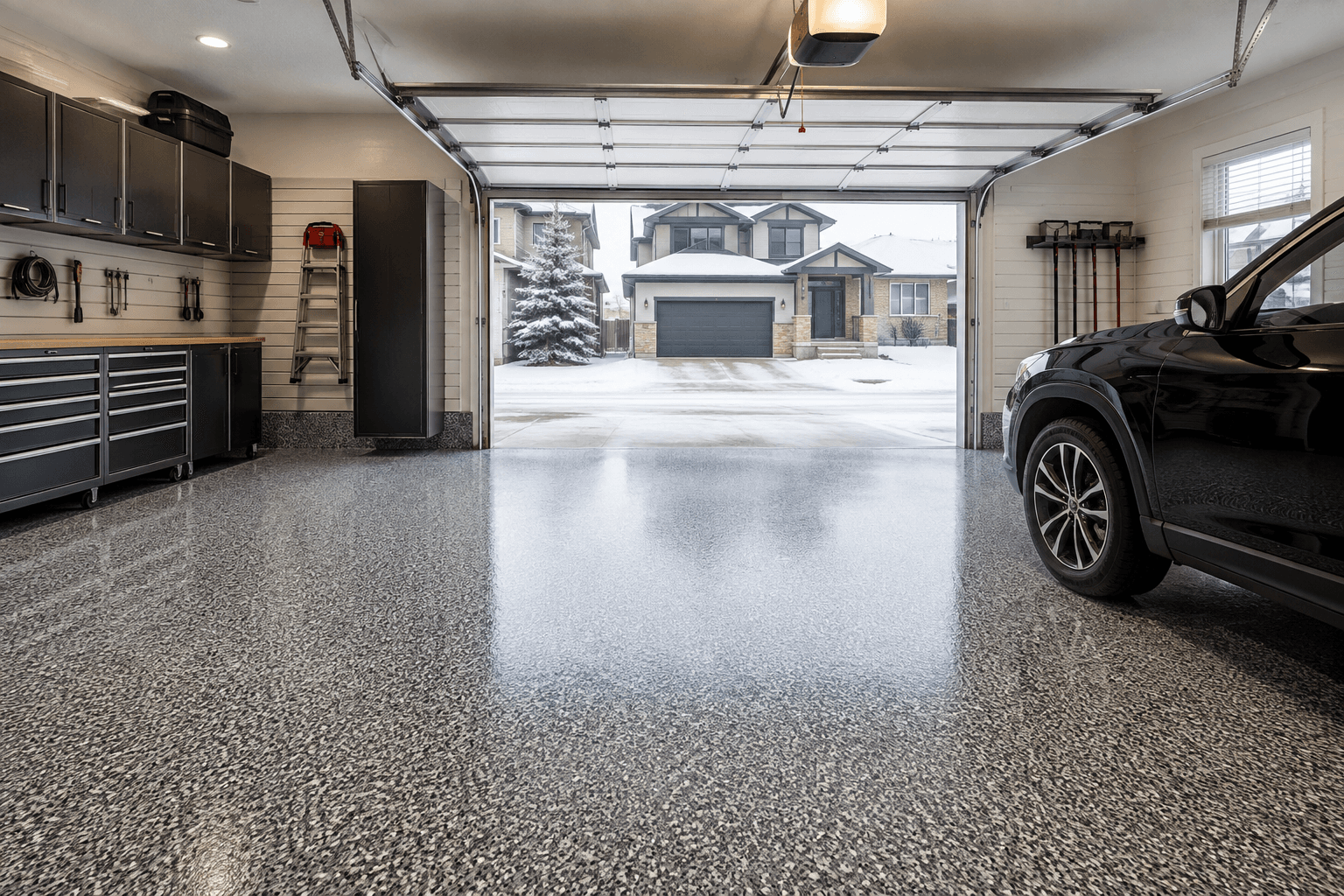
Why Calgary Homeowners Consider Garage Flooring
A garage floor takes daily vehicle traffic, winter salt, melting snow, and big temperature swings \u2014 and bare concrete shows it. A protective coating keeps that surface looking good and working well.
Winter and salt
Resists the salt, sand, and slush Calgary winters drag into the garage on tires and boots.
Moisture
A sealed surface stays drier as snow melts off the car, protecting the slab over time.
Durability
Stands up to daily vehicle traffic, tools, and foot traffic without staining or dusting.
Chemicals and oil
Oil drips, coolant, and de-icing chemicals wipe up instead of soaking into bare concrete.
Easier to clean
Sweep or rinse the floor down — no stains, no dust, and no constant scrubbing.
Want a cost picture first? Estimate your garage flooring cost before digging into the details.
Garage Flooring Options in Calgary
Most Calgary garage projects fall into one of three coating families, priced per square foot. Here's what each one is, its trade-offs, and who it tends to suit.
Polyurea, quartz, and metallic systems are variations on these themes — faster-curing, more textured, or more decorative. To compare options against Calgary market pricing for your garage, run them through the garage flooring cost calculator.
What Does Garage Flooring Cost in Calgary?
Coating is priced per square foot against a long list of variables — not as a fixed price per job. Any figure you see online is a starting point, not a price. These are the factors that actually move the number for a Calgary garage:
Square footage
The size of the floor area, and whether steps and stem walls are coated too.
Concrete condition and preparation
Grinding, degreasing, and profiling the slab is often the biggest driver of a quote.
Cracks and repairs
Crack filling, patching, or injection work before the coating goes down.
Coating system and layers
Epoxy, polyaspartic, flake, polyurea, quartz, and metallic all price differently, and primers and topcoats add up.
Decorative finish
Flakes, metallic pigments, or quartz add material and labour on top of the base system.
Moisture and existing coating
Vapour testing or mitigation, and removing or profiling an old paint or coating, add to the job.
Labour and access
Layout, site access, and the time prep genuinely takes all affect the final number.
Project complexity
Odd layouts, tight clearances, or extra details mean more time on site.
Product quality and warranty
Higher-grade systems and longer warranties cost more up front but can save money over the life of the floor.
Get a Personalized Estimate Instead of a Guess
Instead of relying on a generic national average, FloorQuote helps Calgary homeowners estimate their project based on garage size, floor condition, and coating options — so the range you get reflects your garage, not a one-size-fits-all number.
Estimate Your Garage Flooring CostWant a deeper look at what drives prices? See our complete guide to garage flooring cost in Calgary. Not sure which coating system fits? Compare epoxy vs polyaspartic garage floors.
Garage Flooring vs. Paint, Concrete, and Other Options
Some homeowners already have bare concrete or painted floors and wonder how a coating compares. Here's an honest side-by-side of the most common starting points.
| Option | Appearance | Durability | Best for | Maintenance considerations |
|---|---|---|---|---|
| Bare concrete | Raw, unfinished look | Prone to staining, dusting, and moisture absorption over time | Budget-first homeowners who don’t mind patching stains | Constant sweeping; oil, salt, and moisture leave marks |
| Garage floor paint | Low-cost, solid colour | Thin film that can chip and peel under vehicle traffic or salt | Quick cosmetic upgrades on low-traffic floors | Wears unevenly and often needs re-coating sooner than expected |
| Epoxy coating | Wide colour range; can be flaked | Hard and chemical-resistant; lasts years with proper prep | Homeowners who want durable protection at a moderate cost | Easy to clean; avoid harsh chemicals |
| Polyaspartic coating | UV-stable with fast-install options | Flexible and long-lasting; cures quickly | Attached garages, sunlight, and busy households | Low maintenance; wipe up spills |
| Decorative flake system | Textured, custom speckle finish | Depends on the base system; texture hides everyday wear | Garages used as workshops or show spaces | Sweeping handles most debris; a quality topcoat protects the finish |
These are general descriptions, not guarantees. Ask any installer to walk you through the specific products they'd use on your floor.
How Garage Floor Coating Works
Most professional garage floor projects follow the same four stages. Knowing them helps you ask better questions when you get quotes.
- 1
Inspect & prepare
The installer checks the concrete’s condition and mechanically grinds or profiles the slab so the coating can bond. Preparation is where a coating is won or lost.
- 2
Repair & clean
Cracks are filled or patched, then dust and debris from grinding are removed so the next layers go down clean.
- 3
Apply the coating system
Primer or base coat, the decorative layer (flakes, metallic, or quartz) if you’ve chosen one, and a protective topcoat — each given time to cure.
- 4
Finish & inspect
The installer checks coverage, texture, and edges before the garage is handed back.
How to Choose a Garage Flooring System
Start with what your garage actually needs. Four questions narrow down the right category.
Budget
What you’re comfortable spending — including preparation, which is often the hidden cost.
Durability & vehicle traffic
How many vehicles, and how heavy the day-to-day use really is.
Appearance
Solid colour, flake, or metallic — how you want the garage to look.
Climate & chemical resistance
Winters, road salt, and oil changes — sealed surfaces handle all three far better than bare concrete.
Not sure which system fits?
Use the calculator to compare options for your specific garage, with Calgary market pricing \u2014 before you contact any company.
Estimate Your OptionsCalgary-Specific Considerations for Garage Floors
A garage floor in Calgary doesn't have the same life as one in a milder climate. Here's what's different about planning and installing a coated floor here.
Freeze-thaw cycles
Calgary swings between mild afternoons and overnight freezes all winter. Concrete expands and contracts each cycle, which is why flexible coating systems and careful prep matter here.
Application timing
Most coatings have minimum application and cure temperatures. Installers plan the schedule around the weather — spring, summer, and fall are the typical coating seasons.
Heated vs. unheated garages
Attached, heated garages are easier to coat in winter and give coatings more reliable cure conditions. Detached, unheated garages need more careful planning.
Older Calgary slabs
Homes across Calgary have slabs of different ages and conditions. Older concrete can be coated, but it needs extra prep — and that shows up in the quote.
Surface preparation
Salt, moisture, and freeze-thaw stress a coating’s bond, so grinding and profiling matter even more here than in milder climates.
Detached garages
Detached garages see bigger temperature swings and more condensation in winter, so moisture control and prep matter even more there.
Garage Flooring FAQs
Straight answers to the questions Calgary homeowners ask most often.
How much does garage flooring cost in Calgary?
It varies widely, because pricing depends on square footage, concrete condition, surface preparation, the coating system, the number of coats, and extras like flakes, steps, and moisture work. A realistic next step is an estimate based on your specific garage: our cost calculator uses Calgary market pricing and accounts for these factors, or you can request quotes from local flooring professionals.
What is the best garage floor coating for a Calgary garage?
There’s no single best system — it depends on your budget, how you use the garage, and your concrete’s condition. Epoxy is a proven, budget-friendly choice; polyaspartic cures faster and resists UV yellowing; flake systems add texture and a custom look. Talk to an installer about your situation, and get estimates for more than one option so you can compare.
Is epoxy good for garage floors?
Yes. Epoxy is one of the most popular garage floor systems because it’s durable, chemical-resistant, and relatively affordable. Success depends heavily on surface preparation, and some epoxies can amber or yellow with strong UV exposure — so discuss your garage’s sun exposure with your installer.
Is polyaspartic better than epoxy?
It depends on what matters to you. Polyaspartic cures much faster, is more flexible, and resists UV yellowing better, but it generally costs more. Epoxy offers strong adhesion and value at a lower price point. Both can serve a garage well with proper preparation — it’s a trade-off, not a clear winner.
How long does garage floor coating last?
Lifespan depends on the system, surface preparation, and how the floor is used. Epoxy systems commonly last in the 5–10 year range, while polyaspartic systems are frequently quoted in the 10–15+ year range. Quality preparation and basic maintenance are the biggest factors in reaching those numbers.
Does garage floor coating work in cold weather?
Installed coatings handle cold weather fine once cured. Application is the temperature-sensitive part — most coatings have minimum application and curing temperatures. That’s why installers schedule around the weather, and why heated attached garages are easier to work in during Calgary winters.
Can garage floor coating be applied to old concrete?
Yes, in most cases. Older concrete can be coated as long as it’s structurally sound, clean, and properly prepared. Cracks and damage get repaired first, and the prep work may add to the cost — which is exactly why an in-person look beats a phone estimate.
What should I ask a garage flooring contractor in Calgary?
Ask what surface preparation is included in the quote, which system and how many coats are used, how moisture issues are handled, what the warranty covers, and how long your garage will be out of commission. Preparation time is usually the variable that moves the final number.